
Largest Solar Farms in the World: How Does Yours Measure Up?
 Topic: big solar projects |  Read Time: 10 mins |
 Landowner type: Independent landowners | Institutional landowners | Professional advisers |  Energy: Solar |
 22nd March 2024
Are you curious about the largest solar farms in the world and how they compare to projects in your region? This list highlights the most significant solar developments shaping global energy production.
It’s no secret that solar energy is seeing a slow (but steady) boost worldwide. It’s said that up to 25 per cent of global energy could come from solar production by 2050, and that’s a massive increase from the 4.5 per cent we see today.
To me, this comes as no surprise. Not only is solar energy affordable, but solar farms are generally constructed quickly and require little maintenance during their lifetime. It’s no wonder solar farms are an attractive investment for landowners and commercial energy companies alike.
But just how big can these projects get? The answer: absolutely massive.
If you’re curious about the sheer scale of these projects, keep reading as we run through the largest solar farms in the world.
Who knows? You might even be inspired to start your own.
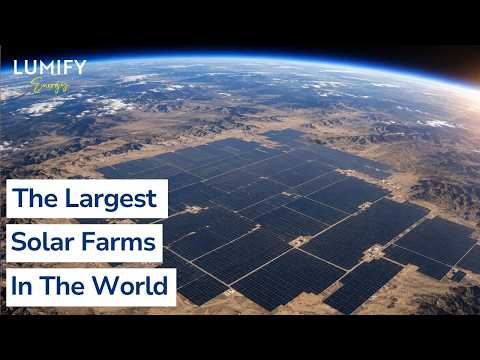
What Is Considered a Large Solar Farm?
A standard solar farm in the UK spans anywhere from 1 to 100 acres.
When a project exceeds the 5 MW capacity mark, it’s generally considered large.
So, anything above this level is undoubtedly a sizable solar farm – especially if we’re getting into the gigawatt range.
The Largest Solar Farms in the World: The Top 12 Contenders
If you’re interested in the largest solar farms in the world, here are some of the most enormous sites.
We’ll be counting down from largest to smallest, with every project on this list boasting a capacity of at least 1 GW.
1. Golmud Solar Park – China

 ©2025 Airbus, CNES / Airbus
Size: 640 acres
Capacity: 2.8 GW

If you’re looking for the largest solar farm in the world, you can’t overlook Golmud Solar Park.
Built in 2011 and completed in 2019, this PV-powered plant spans 640 acres. It boasts an enormous capacity of 2.8 GW but is looking to expand to a mind-blowing 16 GW capacity further down the line.
The solar park comprises 70 different solar plants on the same property, offering enough energy to power over one million houses.
Although it’s currently the largest solar farm in the world, there’s no telling whether it’ll be beaten for capacity in coming years.

2. Bhadla Solar Park – India
 ©2025 Airbus, Maxar Technologies
Size: 14,000 acres
Capacity: 2.7 GW
Tucked away in the Desert of Rajasthan, Bhadla Solar Park spans 14,000 acres and has a capacity of 2.7 GW.
This project is being developed in four phases, with a total investment fund of $1.4 billion. The second phase was completed in 2019, and the other phases are set to be completed within the next few years.
Its current capacity is enough to power over 4.5 million Indian households, making it a significant step towards net-zero efforts.
If that wasn’t appealing enough, the park benefits from stellar conditions. Benefitting from over 300 sunny days a year and an average solar irradiation of 5.72 kWh/m², it’s a slam-dunk of a solar project.
3. Pavagada Solar Park – India
 ©2021 Maxar Technologies
Size: 13,000 acres
Capacity: 2 GW
Pavagada Solar Park is another one of the largest solar farms in the world, offering an impressive capacity of 2 GW.
Found in the Tumkur District of Karnataka, it’s India’s second-largest solar farm, costing a whopping $2.1 billion to build.
Although it’s not currently the biggest solar farm in the world, it’s expected to expand its capacity by 3 GW over time. This could allow it to overtake Golmud in a few short years.
However, there is a downside to this particular solar farm. Because of its sheer scale, keeping the panels free from dust has become a huge challenge.
Local farmers are responsible for cleaning over 400,000 panels. As over two litres of water is needed to clean each panel, the water use is massive (especially considering the project is meant to be environmentally friendly). This has put additional strain on an already over-tapped groundwater supply.
4. Mohammed bin Rashid Al Maktoum Solar Park – UAE
 ©2024 Airbus
Size: 19,027 acres
Capacity: 1.63 GW
When looking at the largest solar farms in the world, we need to include the up-and-coming Mohammed bin Rashid Al Maktoum Solar Park.
It’s the world’s most expensive solar farm, costing $13.6 billion to build as part of the Dubai Clean Energy Strategy for 2050.
This enormous project has a capacity of 1.63 GW but is looking to extend by a further 5 GW by 2030. This would increase its total capacity to a mind-blowing 6.63 GW.
With its current capacity, it powers 270,000 homes and offsets 1.6 million tons of CO2 every year. So, it’s certainly a welcome addition to the Dubai desert.
5. Benban Solar Park – Egypt
 ©2022 Airbus
Size: 9,142 acres
Capacity: 1.65 GW
Perched around 650 km south of Cairo, this project aims to increase Egypt’s share of renewable energy to an impressive 42 per cent by 2035.
The entire solar park includes 34 separate solar power plants and aims to reduce carbon emissions by two million tonnes each year. The park will also produce a whopping 3.8 terawatt hours of electricity annually.
Although smaller than other solar farms, it’s set to increase its capacity to 1.8 GW in the next few years. So, watch this space.
6. The Tengger Desert Solar Park – China
 ©2024 Airbus
Size: 10,625 acres
Capacity: 1.547 GW
Another Chinese contender on our list of the largest solar farms in the world is Tengger Desert Solar Park.
It comes in with a capacity of 1.547 GW and sits at the southern edge of the Gobi Desert (which gets plenty of sun).
This solar park supplies over 600,000 homes and significantly adds to China’s 2,919 GW overall solar generation capacity.
7. Noor Abu Dhabi Solar Power Project – Abu Dhabi
 ©2024 Airbus
Size: 4,447 acres
Capacity: 1.2 GW
Another UAE-based solar farm is the Noor Abu Dhabi Solar Power Project (which is also the world’s largest stand-alone operational solar plant). With a capacity of 1.2 GW, this large-scale solar farm boasts over 3.3 million solar panels on one site.
What makes it one of the most impressive solar projects in the world is the fact that it offers an excellent levelized cost of electricity. With each unit priced at $0.73 per kilowatt hour, it easily competes with the cost of fossil fuel-generated electricity. Plus, it produces enough energy to power around 90,000 homes.
This plant uses highly efficient monocrystalline panels (the most popular type of solar panel for large-scale projects). This means the project is highly efficient and will capture tons of energy from Abu Dhabi’s sunlight levels.
And with anywhere from eight to 11 hours of sunshine daily, it’s certainly in a good location.
8. Datong Solar Power Top Runner Base – China
 ©2022 Maxar Technologies
Size: 1,590 acres
Capacity: 1GW (to expand to 3GW)
Next up on our rundown of the largest solar farms in the world is Datong Solar Power Top Runner Base in Shanxi.
This site is aiming for a total capacity of 3 GW and has already completed its Phase I stage, bringing it to a current capacity of 1 GW – no small achievement.
It was built in 2016 and cost $138 million to construct – just a fraction of what some of the other contenders on this list cost to build.
9. Jinchuan Solar Park – China
 ©2021 Maxar Technologies
Size: 22,239 acres
Capacity: 1.03 GW
China is leading the game in the solar world, and Jinchuan Solar Park is another notch on its incredible belt of solar projects.
Tucked away in the semi-desert in Jinchuan, it comprises over 15 separate solar plants.
It was commissioned in 2013 and uses photovoltaic technology to produce enough energy to power over 876,000 homes.
10. Kurnool Ultra Mega Solar Park – India
 ©2024 Airbus
Size: 5,932 acres
Capacity: 1 GW
Although it’s smaller than some on this list, Kurnool Ultra Mega Solar Park lives up to its name with an impressive 1 GW capacity. It’s tucked away in Pradesh and cost around $880 million to build.
This is an excellent solar farm because the area is arid (with only 40 rainy days each year). In short, conditions are ideal for solar power production.
The park contains over four million solar panels with 315 to 320-watt capacities, producing enough energy to power the whole of Kurnool. And that’s on a rainy day, so imagine what it can achieve at full power.
11. Yanchi Ningxia Solar Park – China
 ©2024 Airbus
Size: 8,401 acres
Capacity: 1 GW
Yanchi Ningxia Solar Park is a ground-mounted solar project with more than 2.5 million solar panels. With a capacity of 1 GW, its power output is certainly nothing to sniff at.
What sets this solar farm apart is that it’s also used as a goji berry farm. Although it was once barren land, improved soil quality has allowed agriculture to mingle with the panels over time. This project is a perfect example of how solar energy and farming can successfully co-exist.
As one of the largest solar farms in the world still in its early stages, it has the potential to boost its capacity over time.
12. Villanueva Plant – Mexico
 ©2023 Airbus
Size: 5,930 acres
Capacity: First phase at 427 MW and second phase at 327 MW – amounting to 754 MW total
The Villanueva Plant is part of Mexico’s commitment to producing 50 per cent of their overall power with renewables by 2030. So, it’s a highly ambitious project looking to turn the tide of the country’s energy usage.
Although it’s still in its building phase, this ground-mounted project will power almost 1.2 million homes in Mexico once completed.
As one of the newer solar farms on this list, it’s also one of the more environmentally friendly ones. The solar plant has introduced new technology to deal with waste and reduce water consumption.
Saving around 441,700 tonnes of CO2 annually, it’s a jewel in Mexico’s crown.
What Is the Biggest Solar Farm in the UK?
The biggest solar farm in the UK is Shotwick Solar Park in Deeside, which comes in at 220 acres. It generates approximately 68,900 MWh of electricity every year and powers around 13,816 homes.
While this is undeniably impressive, it doesn’t even compare to the largest solar farms in the world.
The next largest projects are Bradenstoke Solar Park at 69.8 MW and Owls Hatch Solar Park at 49.9 MW.
In short, the UK has a long way to go before it’s considered a solar powerhouse.
What Large Projects Are in the Pipeline for the UK?
While the UK is lagging slightly on the solar front, a large project is currently in the works.
Cleve Hill Solar will house around 880,000 panels (considerably more than Shotwick’s 270,000). Theoretically, this should give it a capacity at least three times higher than the current largest solar farm in the UK.
This project will cost £450 million to build and will have extensive battery storage to boost output during less ideal conditions.
The only real downside is that this project has faced much opposition from local groups. This means getting planning permission has been much more challenging for the project.
Generally, solar power isn’t incredibly contested in the UK. However, massive projects often receive backlash as there’s fear that they may lead to homes being devalued.
The Future of Solar Power: How Big Can Farms Get?
It’s tricky to say just how big solar farms could get in the future (and we’re already well on our way to mammoth solar parks).
However, there’s a lot of unrealised potential in areas like Africa that can offer as much as 5.48 kWh per m² per day of direct sunlight. The main issue is achieving reliable and sustainable investment to bring these plans to light.
But there is some hope, China has invested around $13 billion to develop Africa’s clean energy capacity. While not all of this is invested in solar, it’s certainly a step in the right direction.
There You Have It: The Ultimate Guide to the Largest Solar Farms in the World
If you want to make money from a project on your land, feel free to contact us at Lumify Energy. Our expert team will assess your land and guide you through the process of making reliable, passive income from leasing your spare acreage.

Check Your Chances of Getting Solar Planning Permission
Use our free Solar Farm Planning Permission Checker to see how likely your land is to get planning approval — quick, simple, and no obligation.


