
Capital Gains Tax on Land Used for Renewable Energy Projects
 Topic: capital gains tax Topic: capital gains tax |  Read Time: 7 mins Read Time: 7 mins |
 Landowner type: Landowner type:Independent landowners | Institutional landowners |  Energy: Energy:Onshore wind | Solar |
 1st April 2026
Selling land with a renewable energy project can be one of the more profitable (and complex) transactions a landowner undertakes.
Development transforms a site’s value. Farmland worth £10,000 per acre might be worth many times more once it secures planning consent for a collection of solar panels (known as a solar array), has wind farm foundations in place or receives a grid connection agreement to the National Grid.
That transformation is welcomed when it comes to income, but it also brings a sizable, potential tax burden to the table. So, how much of the gain is the landowner’s, and how much will go to HMRC in Capital Gains Tax (CGT)?
Unlike rental income from a lease which is taxed as annual income, the sale of renewable project land creates a one-off capital event. This means a potentially large CGT bill (often at the higher tax rate) unless reliefs, allowable costs or structuring strategies are carefully considered and applied.
In this guide, I’ll discuss:
- Why land used for renewable energy projects attracts higher gains.
- How CGT is calculated in practice.
- The current rates that apply.
- Which costs you can deduct to reduce your liability.
- Relevant tax reliefs and exemptions for renewable projects.
- How you can minimise the CGT on your land.
Why Renewable Projects Attract Higher Capital Gains
One of the biggest drivers of large CGT bills on developed land is the income-generating potential that renewable energy projects unlock.
Traditional agricultural land often delivers modest, predictable returns. But land with an established wind, solar or battery storage project can generate substantial income from clean energy production. This is typically through long-term Power Purchase Agreements (PPAs) or fixed lease structures.
This shift in use from low-yield agriculture to high-income infrastructure transforms the site’s economic value. And that transformation is reflected in the gain, which HMRC sees as taxable.
Here are some other reasons why developed land creates higher gains.
Permanent infrastructure
Renewable energy projects involve long-term and sometimes permanent infrastructure that can be expensive to maintain.
For example:
- Grid connections and substations: These can cost hundreds of thousands of pounds and often make the difference between a site being viable or not. Once built, they add enormous commercial value because grid access is limited.
- Foundations and access roads: Turbine bases, solar mounting systems and permanent access tracks are capital works that remain part of the site, making it more attractive to buyers.
- Security and drainage systems: Fencing, gates and surface water management are all permanent features that add to saleability.
These factors mean that developed land can trigger much higher CGT bills compared to its more undeveloped counterparts.

Change of use
Agricultural land benefits from some favourable tax treatments, such as Agricultural Property Relief (APR) for inheritance tax. Once it’s developed for renewable energy, it’s typically reclassified as commercial property, which removes APR and alters how gains are treated.
HMRC guidance is explicit: land ‘used for commercial purposes’ doesn’t qualify for APR. So while the uplift in value is positive, the tax profile becomes less forgiving.
For landowners, this combination of higher valuations and less generous reliefs explains why renewable energy sites can trigger significantly higher CGT bills than undeveloped farmland.
The key point for landowners
The more income potential a buyer sees in your land (whether realised or not), the higher the valuation. And that means a bigger CGT bill unless you’re well-prepared with reliefs, cost documentation and structuring strategies.
So while the income opportunity is welcome, it comes with a tax trade-off that’s important to factor into your long-term planning.
Calculating CGT for Developed Land
CGT is paid on the gain (the profit you make from selling the land), not the full sale price.
The gain is calculated as:
- Sale price – Base cost – Allowable costs = Taxable gain
The base cost includes what you originally paid for the land and any qualifying costs incurred when you bought it. Allowable costs are capital expenses directly linked to improving or selling the land.
For example:
A landowner buys a 30-acre site in 2005 for £200,000. They invest £150,000 in infrastructure (roads, fencing and a grid connection) for a renewable energy development.
In 2024, they sell the site for £1,200,000, incurring £25,000 in legal, planning and agent fees.
So, the taxable gain is:
- £1,200,000 – £200,000 – £150,000 – £25,000 = £825,000
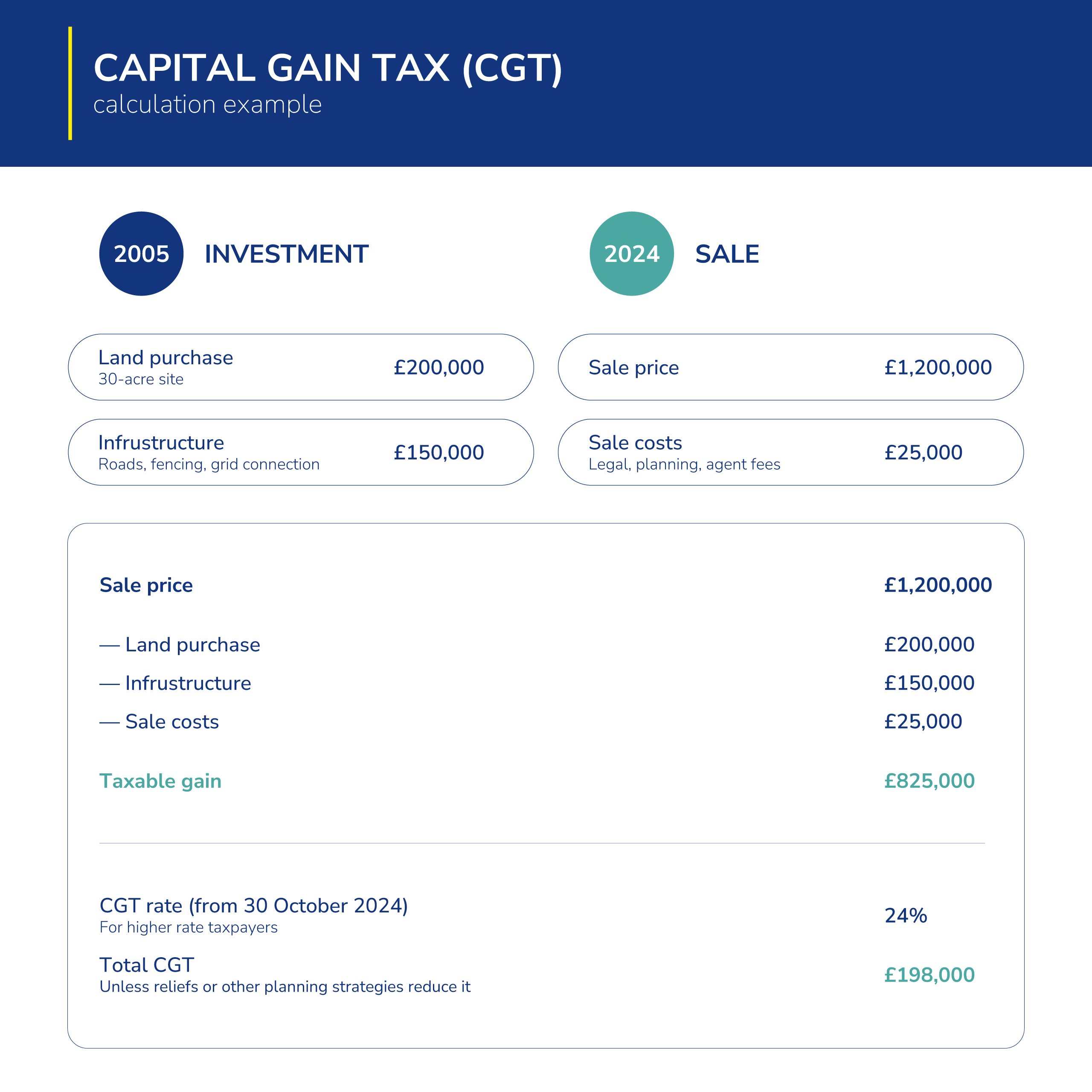
From 30 October 2024, if the seller is a higher-rate taxpayer, they’ll pay 24% CGT on most or all of the gain, resulting in a bill of £198,000.
Unless reliefs or other planning strategies reduce it, that is.
Current UK CGT Rates for Developed Land
CGT is applied at different rates depending on your income level and the type of asset. For land used for renewable energy (classified as non-residential property), the rates are:
- 18% if the gain falls within your unused basic-rate income tax band.
- 24% for all gains above that threshold.
Most landowners selling renewable sites will find that the scale of the gain pushes them into the higher rate.
Example
A farmer with an annual income of £35,000 sells land hosting a solar project for a gain of £500,000. Even though they’re a basic-rate taxpayer normally, the sale pushes most of the gain into the 24% CGT bracket.
Companies and Special Purpose Vehicles (SPVs)
Where renewable projects are held in a company or SPV, there’s no separate CGT. Gains are taxed through Corporation Tax:
- 19% for profits up to £50,000.
- 25% for profits over £250,000.
- A tapered rate applies between £50,000 and £250,000.
In practice, many renewable projects are developed within SPVs precisely so that shares in the company can be sold, rather than the land itself. This can be more tax-efficient for both buyer and seller.
How to Reduce the Taxable Gain on Your Site
Claim any allowable costs
Allowable costs are one of the most effective ways to reduce your liability for CGT on land. And many landowners underestimate how much they can deduct.
The starting point is the original purchase price of the land, but this is just the beginning. Any professional fees connected to both buying and selling, such as conveyancing, surveyor reports, planning consultants and estate agent commissions, can be deducted.
More importantly for developed sites, you can claim capital improvements that have increased the value of the land.
This includes:
- Installing infrastructure such as access roads, drainage systems or utility connections.
- Building site fencing, gates or other security measures that are permanent in nature.
- Laying foundations or creating platforms for renewable energy infrastructure.
- Paying for environmental remediation or compliance works that made the land usable for commercial purposes.
For renewable energy projects, costs such as grid connection fees (which can run into hundreds of thousands of pounds) are fully deductible as they are capital in nature.
What’s not listed under allowable costs
What you cannot deduct are general running costs or repairs. For instance, fixing potholes in an existing track is considered maintenance, but undertaking activities to enhance the road above its original condition is technically a capital improvement.
The difference is important and should be backed by detailed invoices and records to withstand any HMRC review.
Use any tax reliefs and exemptions that may apply
Several reliefs can reduce or defer CGT liability:
- Annual Allowance: Each individual can exempt £3,000 (as of the 2024/25 tax year). Joint owners can double this.
- Business Asset Disposal Relief (BADR): This reduces CGT to 10% for qualifying disposals, up to a £1 million lifetime limit. This generally applies if you actively operate the renewable business, not if you simply lease land.
- Rollover Relief: This defers CGT if proceeds are reinvested into another qualifying business asset (such as another renewable site or commercial property) within three years.
- Incorporation Relief: This defers CGT when transferring land into a company in exchange for shares.
- Gift Hold-Over Relief: This defers CGT when gifting land, and is useful for succession planning.

Use multiple years’ CGT allowances
Selling the freehold of a developed renewable site crystallises a large one-off CGT bill.
One effective approach for reducing GCT is timing the sale or the transfer of assets over several tax years. This way, you can use multiple years’ CGT allowances. And in doing so, you can possibly keep part of the gain within the lower rate band.
Keep in mind that VAT is another factor – if your land is ‘opted to tax’, a sale may require VAT to be charged, and this must be considered alongside CGT.
Spread taxable income over your lease term
If you lease your site to an operator, it spreads taxable income over the lease term, which may result in a more manageable tax position.
Transfer some of the ownership to your spouse
Another strategy is ownership restructuring. Transferring a share of the land to your spouse before a sale doubles the available allowances and can lower the effective rate if they’re in a lower tax bracket. This must be done as a genuine transfer of beneficial ownership, not simply on paper.
Sell shares, instead of the land itself
For some owners, selling shares in a company that owns the land rather than selling the land itself can offer significant tax benefits – especially if other contracts or assets are included. Share sales may avoid certain transaction taxes and, depending on the buyer’s circumstances, be more attractive commercially.
Keep detailed files
Finally, record-keeping is a simple but often overlooked way to reduce CGT on land. Keep a detailed file of all capital costs, including invoices, bank statements, and contracts.
If HMRC queries a deduction and you cannot provide evidence, you may lose the claim. This could cost you tens of thousands in extra tax.
Final Takeaway
Capital Gains Tax on land can be substantial when a site has been developed. But careful planning, a solid understanding of available reliefs and the right ownership structure can help you keep more of your profits.
If your land has been developed for renewable energy, housing or other commercial purposes, the best time to start CGT planning is long before the sale. This gives you the opportunity to structure the transaction efficiently, capture all allowable costs and ensure you are making full use of reliefs.
Want to stay ahead of the curve? Subscribe to the Green Light Blog for straight-talking insights, renewable energy news and practical advice tailored to landowners like you.
Subscribe to

Helping you to get the most from the project on your land


